No Room at the Hostel
The phone rang just as Gareth was working through the second mouthful of his ham and crisps sandwich. The spreadsheet on his screen was finally behaving, showing three housing cases had moved from urgent to resolved. He placed his pen parallel to the keyboard and swallowed the bread, ham, and crisps with a side of resentment.
“Housing, Gareth speaking.”
“Gareth,” Bronwen said, “Tregaron office has rung. They’ve got a man stranded down there. One leg, no transport, wants to go further south, but the flooding’s shut the roads.”
Gareth closed his eyes. The sandwich sagged in his hand. “Further south is an ambitious request during a flood.”
“Aran’s off with a bug, Iolo’s stuck behind a fallen tree, and you’ve got no appointments after three.”
“I had plans after three.”
“Did those involve a sandwich and a pint?”
“Might have.”
Bronwen gave the smallest sigh. “He needs help, Gareth.”
There it was. Unfair, that. The whole council ran on unfair sentences, with needs help in the middle. Gareth touched the warm metal tag under his shirt from habit, but it offered no warning, no hum, no useful intervention from the afterlife. Cŵn Annwn on a full moon, housing officer on a wet Thursday. Apparently, both jobs involved people going where they weren’t meant to and nobody else being free.
“All right,” he said. “If my car gets filthy, I’m claiming the car wash on expenses.”
Tregaron’s car park was ankle deep in brown puddles. The office there had damp carpet tiles, strip lights, and a reception hatch that stuck halfway down. Gareth signed the visitor book because civilisation depended on minor acts of faith.
The receptionist pointed through the glass doors. “That’s him now.”
A man crossed the forecourt in a brown coat and a baseball cap. One trouser leg was pinned up. One polished black boot landed neatly on the wet concrete. The man carried a bag in his right hand that acted as a counterweight for balance as he hopped towards him. He was moving faster than Gareth expected.
A faint headache gathered behind Gareth’s eyes. It had none of the force of a proper Cŵn Annwn warning, but was similar in feeling to when Rhian left the filing cabinet drawer open a fraction. Then it vanished.
The man gave a half wave from the doorway. His face was lined, cheerful, and soaked. Rain dripped from his cap brim onto the mat.
“Mr Hopkin?” Gareth asked.
“That’s me. Lovely of you to come all this way.”
“It’s rough out there.”
“Terrible for travelling.”
“That’s rather the theme of the afternoon. I’m told you wanted to go south.”
“If possible.”
“It isn’t.”
Mr Hopkin absorbed that with admirable calm. “A youth hostel, then.”
The receptionist’s mouth tightened behind the hatch.
Gareth had dealt with worse. He had once explained to a man in a dressing gown that a communal stairwell couldn’t be used as a smoking lounge because smoke rose, neighbours complained, and dressing gowns did not create tenancy rights. Compared with that, a hostel search in a flood felt almost wholesome.
He rang the YHA. The building was under refurbishment. The booking line transferred him twice, apologised once, and then died.
“There’s a hotel,” the receptionist said. “Only room left is on the first floor.”
Gareth faced Mr Hopkin. “It’s upstairs.”
“I could take a look?”
The hotel was above a pub that stunk of fried onions, which meant cheaper prices for the Council. The steep stairs climbed from a narrow side door, carpeted in red wool that had lost several arguments with muddy boots.
Mr Hopkin sprang upward.
Gareth paused on the first step. The man moved with unsettling economy. No wobble, no fuss, no flapping about. Gareth followed, puffing by the turn in the stairs and annoyed with himself for admiring the technique.
The room was pretty bare by all accounts. It had a bed, and a painting of a boat that leaned into a storm. The bathroom was shared across the whole floor. Mr Hopkin stood on the threshold and gave the stairs a long, solemn assessment.
“Too steep.”
Gareth swallowed several replies. “You got up them well.”
“Yes,” Mr Hopkin said. “That’s why I checked.”
A reasonable answer, unfortunately. Gareth hated those.
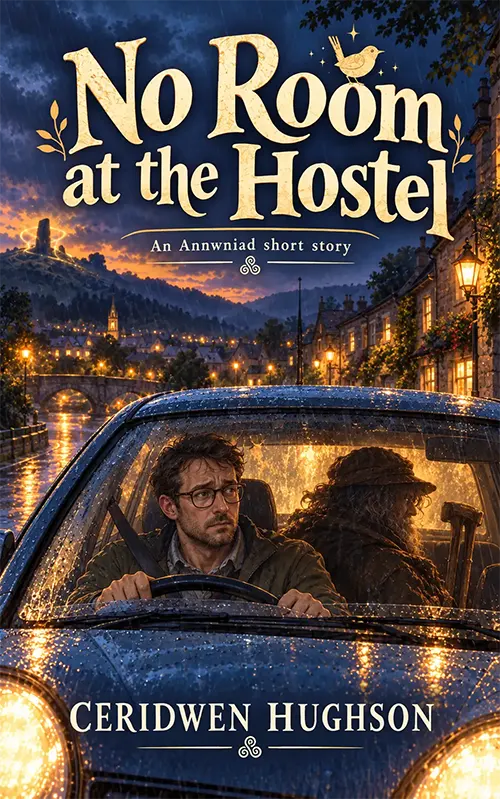
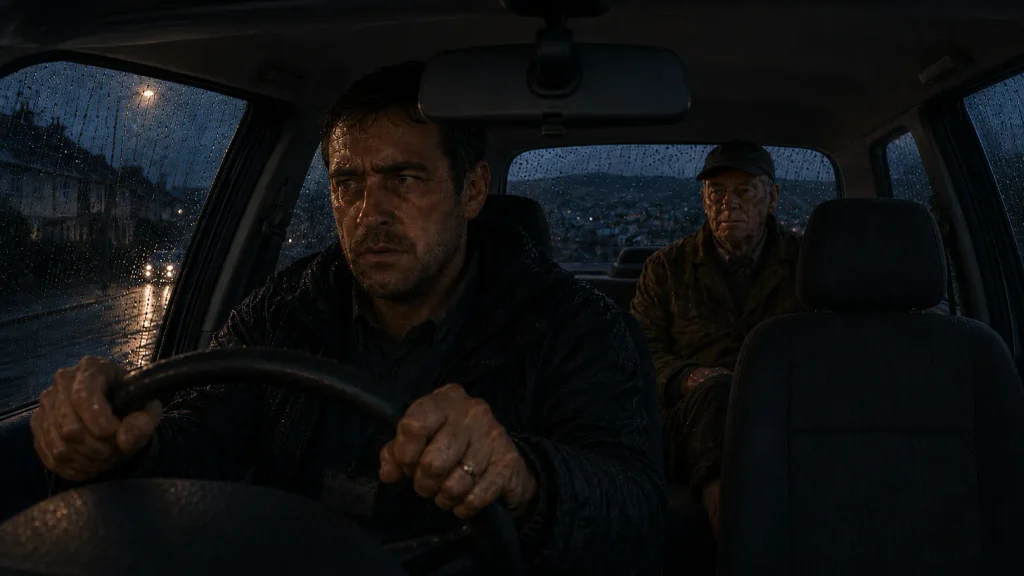
Back in the rain, the car was already misted inside. It was a two-door Fiat that treated passengers as an unwanted rumour. Gareth pulled the front seat forward.
“You can sit in front if it’s easier.”
Mr Hopkin’s hand tightened on his stick. His smile remained in place. “I never sit beside a driver.”
“Right.”
“Back will do.”
“It’s cramped.”
“I fold well.”
He did. That was the problem. Mr Hopkin tucked himself into the rear seat easily. Gareth’s skin prickled, and he imagined the car filling with the scent of wet stone under moss and a road after midnight.
Mr Hopkin sneezed.
The scent returned to vanilla vape residue, and rainwater. Gareth fastened his seat belt and told himself to stop being so dramatic. The man needed a bed. The weather was foul. The system was stretched. That was all.
The drive north was a slow argument with water. Flood signs shone in the headlights. Lorries sent brown spray over the windscreen. Mr Hopkin hummed in the back, never quite a tune, never quite random. Each bridge gave Gareth a tiny ache in his jaw.
“We can try Aberystwyth.”
Warmth moved under his shirt.
“A ground-floor room came up this morning on the sea front. Very picturesque.”
The tag gave a faint pulse, then slept.
“I’ll get you there.”
Mr Hopkin’s hum deepened.
Gareth tightened his fingers on the wheel. He was not being warned. He was tired, cold, and irritated because a stranger had made him drive half of Wales through a flood. A person could feel uneasy without it being a supernatural incident. In his experience, most supernatural incidents arrived with a wren shouting instructions or a dog doing workplace induction with its teeth.
“Comfortable back there?” Gareth asked.
“Very good of you.”
“That wasn’t quite my question.”
“No,” Mr Hopkin said pleasantly. “It wasn’t.”
Aberystwyth came into view through orange streetlamp glare and rain. Gareth parked outside the office, shoulders stiff from the drive. The ground-floor room had taken three calls and a promise to chase a maintenance backlog that would probably outlive him.
Mr Hopkin climbed out and settled his coat. “Kindly done. I think I’ll take the train to Borth.”
Gareth stared across the roof of the Fiat. “You’ve got accommodation here.”
“Yes.”
“In Aberystwyth.”
“Yes.”
“And now you want Borth.”
“I can manage from here.”
The tag under Gareth’s shirt went cold.
He could not force a grown man into accommodation. He couldn’t block him in the car park because his teeth were aching. He definitely could not turn all springer spaniel on him outside the civic centre over a feeling he couldn’t put on a form.
“Do you need me to ring anyone?” Gareth asked.
“No need. You’ve been very helpful.”
Mr Hopkin tipped his cap’s brim and hopped towards the station.
Gareth went inside and rang social services because that was what sensible people did when the whole day had gone to pot.
A woman answered on the third ring. Her voice sounded exhausted. Gareth gave the name, the journey, the accommodation refusal, and Borth.
The pause on the line lasted too long.
“Oh, him,” she said.
That tone was loaded with meaning. “You know him?”
“We know him. Gareth, listen to me. Don’t go driving him anywhere.”
“Why?”
“We’ve had a report he could become violent.”
“That information would have been helpful earlier.” Gareth lowered himself into the nearest chair. “I’ve spent several hours driving him somewhere.”
Another pause. A kettle clicked at her end. Somewhere in Gareth’s office, the printer chewed paper.
“Oh, Gareth.”
“I’m getting very tired of people saying my name like I’ve fallen down a well.”
The office window rattled. A small brown wren crashed into the glass, bounced onto the sill, recovered, and stabbed the pane three times with its beak.
Tap. Tap. Tap.
Gareth rushed to open the window. Quill came in sideways, drenched and clearly furious.
“Why,” the wren demanded, spraying rain over Gareth’s out-tray, “does the whole coast smell of an old good deed?”
Gareth kept the phone to his ear. “I’ll ring you back.”
“No, you won’t,” social services said. “You’ll go home.”
He hung up because that advice had missed its hour.
Quill shook himself again. “Who did you transport?”
“A stranded man from Tredegar.”
“What man?”
“Mr Hopkin. One leg. Wants youth hostels and inconvenient geography.”
Quill went incredibly small, then very puffed.
“Coesun,” he said.
“Bless you.”
“One of the old one-footed road folk, Gareth. They come through on traveller routes. They’re meant to go back when the road closes.”
“He appeared human.”
“He was under mortal hospitality. Of course he appeared human. Hospitality doesn’t hide him by making him invisible. It makes the truth rude to mention.”
Gareth’s mouth went dry.
Quill hopped to the phone, then to Gareth’s sleeve, claws catching damp fabric. “Did you offer transport?”
“He was stranded.”
“Did you search for shelter?”
“He needed somewhere dry.”
“Did you say you’d see what you could do?”
Gareth rubbed his forehead. “Possibly.”
“Possibly,” Quill repeated. “You renewed the chain.”
“My senses barely moved.”
“Because the law had already named him guest, traveller, person in need. Your nose found what every decent rule around him agreed he was.”
“That’s weird.”
“That is ancient law. Weird was standard drafting practice.”
Gareth remembered the back seat, the old road scent, the wrongness drowned under wet wool and procedure. “He wouldn’t sit in front.”
“Front seat makes you named guide.”
“And the hotel stairs?”
“Upper-room roof-law. He tested it and declined. He knows his routes.”
“He’s been doing this a while, has he?”
“Fourteen years.”
Fourteen years of lifts, hostels, cups of tea, sympathetic receptionists, landlords’ wives, and Welsh people saying go on, I’ll run you up. The Morrígan Department hadn’t failed because Mr Hopkin was powerful. They’d failed because people were kind.
The phone rang.
Gareth answered because reflexes were a curse.
“Gaz?” Idris from The Ship sounded pleased with himself. “You’ll never guess who just came in.”
Gareth closed his eyes. “Don’t say it.”
“One-legged chap. Lovely manners. Asked after a youth hostel.”
Quill made a strangled noise.
“Please tell me you didn’t help him,” Gareth said.
“Well, I felt sorry for him, didn’t I? Rain’s wicked hard here. Nerys has run him up towards Ystumtuen.”
Gareth stared at the wall calendar. A damp sheep offered no comfort at all.
“Did anyone say they’d see what they could do?”
A pub silence opened down the line.
“Well,” Idris said, “I might have.”
Quill flew into the wall.