Annwniad Mythology Guide
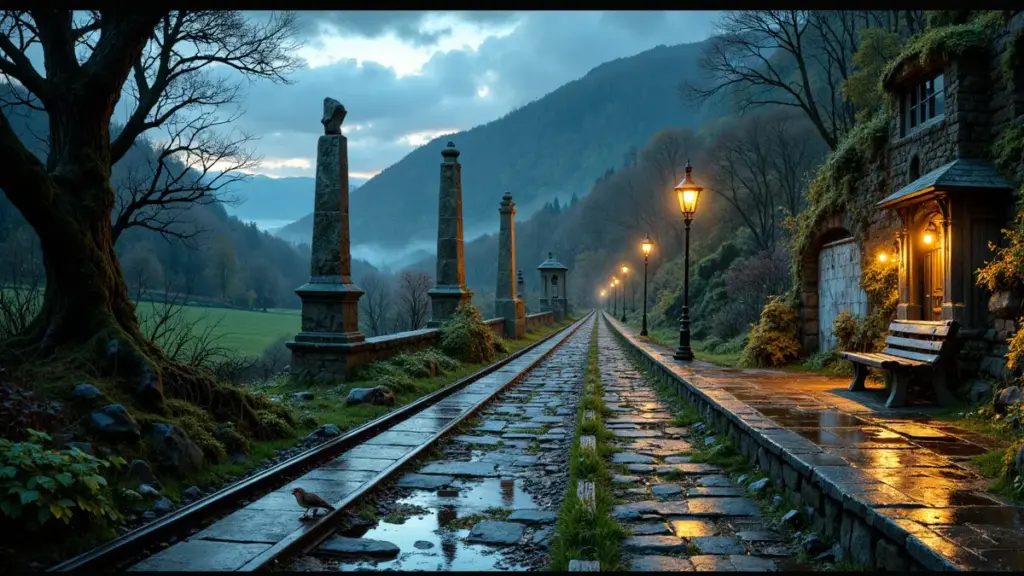
Annwniad is a cosy Welsh fantasy series set in a modern Wales where the Otherworld sits closer than anyone sensible would prefer. Old stories leak through train stations, libraries, rivers, hills, streetlamps, florists, and the occasional deeply inconvenient piece of paperwork.
This guide explains the Welsh mythology, folklore, magical objects, Otherworld figures, spectral hounds, and supernatural bureaucracy that inspire the Annwniad books. Each question has two answers. The Mythology Answer explains the traditional idea in simple terms. The Annwniad Answer explains how that idea works inside the series.
You don’t need to know Welsh mythology before reading Annwniad. The stories are written so you can start anywhere, follow the mystery, and learn the world as the characters do. This page is here for readers who enjoy knowing what lies underneath the magic, the jokes, and the paperwork.
Annwn
What is Annwn in Welsh mythology
The Mythology Answer: Annwn is the Welsh Otherworld. It is often linked with the dead, but it isn’t the same as the Christian idea of Hell. In medieval Welsh tradition, Annwn can be a place of beauty, plenty, youth, magic, and strange power.
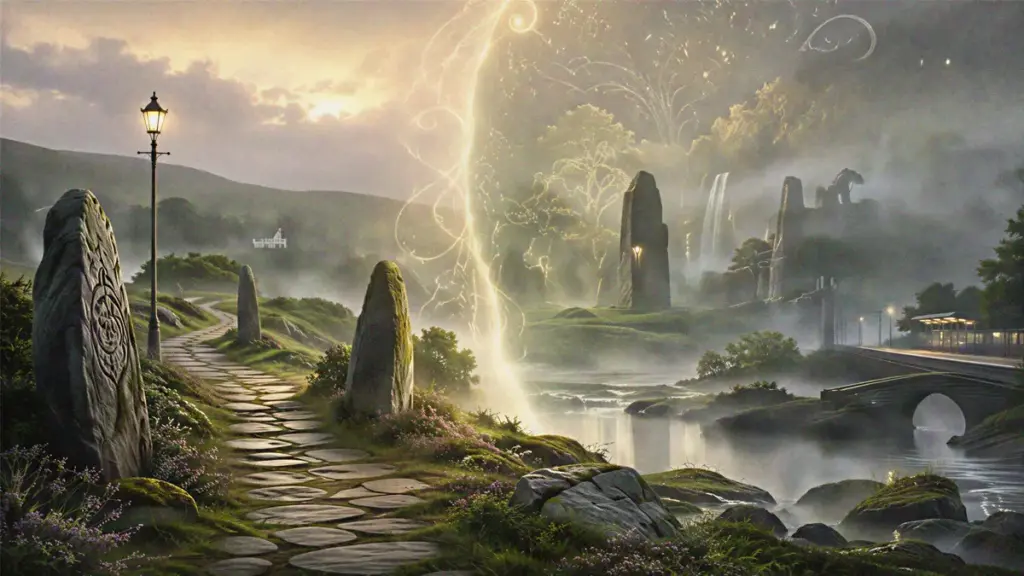
The Annwniad Answer: In the Annwniad series, Annwn sits close enough to modern Wales to cause trouble. Its boundary can press against train stations, rivers, libraries, hills, old buildings, and badly behaved streetlamps. Most people blame damp, faulty wiring, or council incompetence. The Morrigan Department knows better.
Who rules Annwn?
The Mythology Answer: Annwn is traditionally associated with powerful Otherworld rulers, especially Arawn, who appears as king of Annwn in the First Branch of the Mabinogi. Gwyn ap Nudd is also linked with Annwn, the fair folk, and the Wild Hunt in later tradition.
The Annwniad Answer: In the Annwniad series, rulers such as Arawn and Gwyn ap Nudd sit far above ordinary casework. The Morrigan Department handles the day-to-day trouble. It processes the complaints, breach notices, retrieval errors, lost souls, spectral hounds, and awkward incidents that nobody wants to put on a king’s desk.
Is Annwn the same as Avalon?
The Mythology Answer: Annwn and Avalon are both Otherworldly places in Celtic and Arthurian tradition, but they are not the same place. Annwn is the Welsh Otherworld, while Avalon is more strongly linked with later Arthurian legend.
The Annwniad Answer: In the Annwniad series, Annwn and Avalon are filed in separate departments, which everyone agrees is sensible until a sword, a lost soul, or an immortal prince crosses the wrong boundary and turns a tidy distinction into a full staff meeting.
Is Annwn underground?
The Mythology Answer: Annwn is sometimes imagined as beneath the earth, across the sea, or beyond ordinary human reach. Welsh tradition treats it as an Otherworld rather than a normal physical country with fixed borders.
The Annwniad Answer: In the Annwniad series, Annwn is not beneath the earth, but alongside it. It is the nearest face of a wider system of realms and dimensions. It doesn’t sit underground; rather, it sits slightly misaligned with our reality, separated by boundaries that are prone to frustrating dimensional leaks.
Is Annwn the land of the dead?
The Mythology Answer: Annwn is often linked with the dead, but it is more than a land of death. Welsh tradition also presents it as a place of beauty, plenty, youth, magic, and Otherworldly power.
The Annwniad Answer: In the Annwniad series, Annwn is where the dead, the lost, the misplaced, and the mythic all create administrative pressure. The Morrigan Department exists because the afterlife has boundaries, and boundaries need staff.
Is Annwn one Otherworld?
The Mythology Answer: In Welsh mythology, Annwn is usually spoken of as the Otherworld. The old stories do not present it as a modern map with fixed borders, regions, departments, or dimensions, so different sources may imagine it in different ways.
The Annwniad Answer: In the Annwniad series, Annwn is not only one Otherworld. It is also the name mortals use for a whole system of Otherworlds and neighbouring dimensions. The Annwn most people hear about is the one closest to modern Wales, the realm linked with figures such as Arawn and Gwyn ap Nudd. Other realms move nearer and farther from Earth, but this one locked itself close in prehistory, which is why its gates, hounds, courts, and officials keep turning up first.
Cauldrons in Welsh mythology
What is the Cauldron of Rebirth?
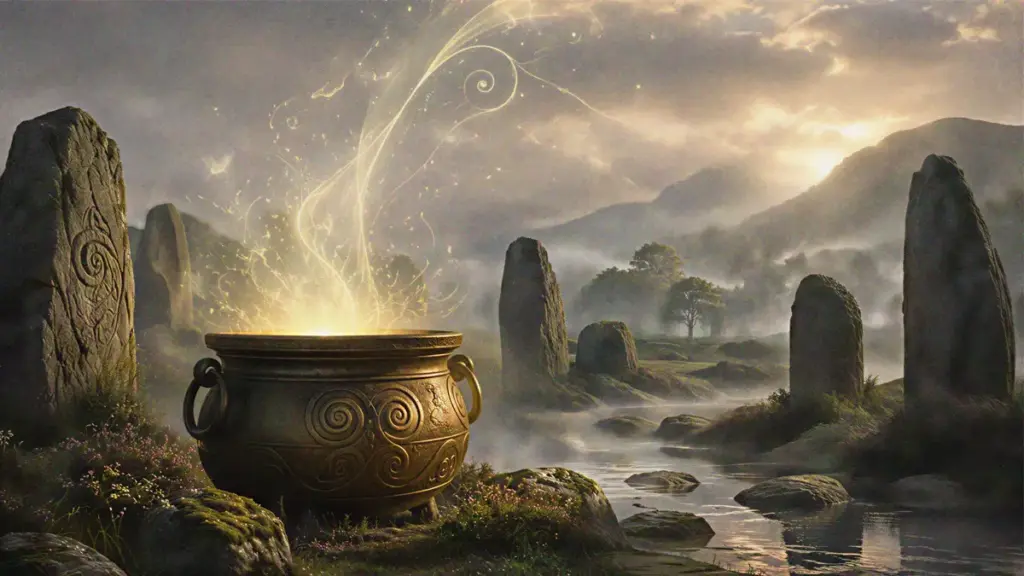
The Mythology Answer: In the Second Branch of the Mabinogi, the Cauldron of Rebirth can bring dead warriors back to life. The returned men cannot speak, which makes the gift powerful, unsettling, and incomplete. It is one of the great magical objects in Welsh mythology, and it plays a disastrous role in the story of Branwen.
The Annwniad Answer: In The Bloodless Florist, Bryn ap Math was reborn in the Cauldron of Rebirth before it was smashed. He lives for ever, but the cauldron did not restore him in an ordinary human sense. Blood makes him super-intelligent. Without it, he becomes a drone soldier who blindly follows orders. He is not a vampire. He is a man who survived an old miracle badly, and he would very much prefer everyone to stop being so dramatic about it.
Is the Cauldron of Rebirth connected to Branwen?
The Mythology Answer: Yes. The Cauldron of Rebirth appears in the Second Branch of the Mabinogi, the branch centred on Branwen, daughter of Llŷr. It becomes part of the conflict between Britain and Ireland, where dead warriors are restored to life but return unable to speak.
The Annwniad Answer: In Annwniad, the Branwen story left damage behind. The Cauldron of Rebirth was not a harmless wonder. It changed the men it restored, and Bryn ap Math is one of the few remaining consequences walking around modern Wales with a link a murder to solve, and a deeply personal dislike of magical nonsense. He’s particularly annoyed at the myth that the returned cannot speak, is just that without the added Intelligence that blood gives, they don’t have much to say.
Is the Cauldron of Rebirth Ceridwen’s cauldron?
The Mythology Answer: Not in the usual medieval material. Ceridwen is best known for her own cauldron, connected with inspiration, transformation, and the story of Taliesin. The Cauldron of Rebirth belongs to the Second Branch of the Mabinogi and the story of Branwen.
The Annwniad Answer: In Annwniad, cauldrons are never just kitchenware. Ceridwen’s work concerns alchemy, transformation, creativity, and controlled destruction, while the Cauldron of Rebirth belongs to an older and more dangerous pattern of restoration. The two are not the same cauldron, but they sit close enough in the magical paperwork to make everyone nervous.
What happened to the Cauldron of Rebirth?
The Mythology Answer: In the Second Branch of the Mabinogi, the Cauldron of Rebirth is destroyed during the war between Britain and Ireland. Its destruction is one of the great turning points in a story already full of grief, betrayal, and terrible consequences.
The Annwniad Answer: In Annwniad, the cauldron was smashed, but that did not undo what it had already made. Bryn ap Math was reborn before the destruction, and he remains one of its unfinished consequences. He is immortal, brilliant under the right conditions, dangerous under the wrong ones, and determined to keep as much distance as possible between himself and the magical world that made him.
Is Bryn ap Math a vampire?
The Mythology Answer: No. Vampires are not part of the medieval Welsh Cauldron of Rebirth tradition. The cauldron restores dead warriors, but it does not make them vampires.
The Annwniad Answer: No, and Bryn would like that stated clearly. Bryn ap Math drinks blood because the Cauldron of Rebirth left him with an unfinished mind, not because he is undead in the vampire sense. Blood lets him think with terrifying clarity. It was intended to create strategic military geniuses. Without it, he becomes a drone soldier who blindly follows orders. He is not a vampire. He is worse and much more annoyed.
Cŵn Annwn
What are the Cŵn Annwn?
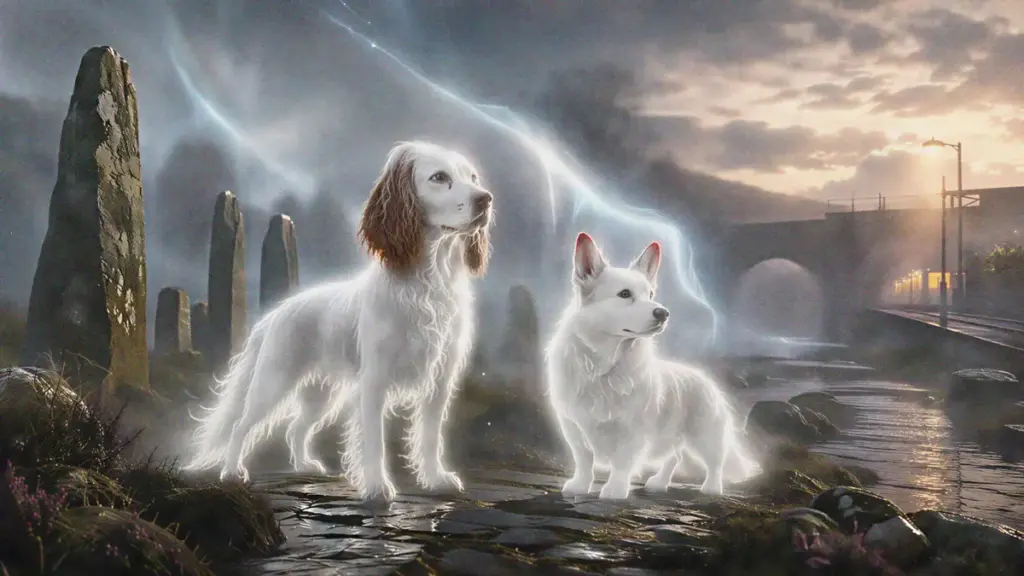
The Mythology Answer: The Cŵn Annwn are the spectral hounds of Annwn, the Welsh Otherworld. They are traditionally described as white hounds with red ears, and they are often linked with death omens, soul journeys, supernatural hunting, and the pursuit of wrongdoers.
The Annwniad Answer: In the Annwniad series, some Cŵn Annwn are weredogs. They live as men until the change takes them, then they turn into Welsh breeds of dog with Otherworld instincts, red-eared hound magic, and very strict rules. Usually, it runs in families, and trained weredogs are far too disciplined to bite people. Gareth is the exception. Colin, an inexperienced teenage corgi, bites him and accidentally turns him into a Cŵn Annwn. Gareth becomes a Welsh springer spaniel, which gives the Morrigan Department a fresh file, several awkward questions, and one very annoyed man with new paws.
What do the Cŵn Annwn sound like?
The Mythology Answer: Welsh folklore says the baying of the Cŵn Annwn behaves strangely. Their cries can sound loudest when they are far away, then grow softer as they come closer. Their call has also been linked with the sound of migrating geese.
The Annwniad Answer: In the Annwniad series, hearing the Cŵn Annwn is rarely comforting. In Aberystwyth, their sound can slip through wind, rain, old stone, bad phone signals, and the spaces between ordinary noises. If the baying gets quieter, the sensible response is to find shelter, check the seals, and hope the Morrigan Department has sent the right form.
Are the Cŵn Annwn evil?
The Mythology Answer: The Cŵn Annwn aren’t simple evil monsters in Welsh mythology. They are spectral hounds of the Otherworld, often feared because their baying can foretell death. In some traditions, they escort souls or hunt wrongdoers, which makes them terrifying rather than wicked.
The Annwniad Answer: In the Annwniad series, the Cŵn Annwn aren’t evil, but you still don’t want one assigned to your case. They’re enforcement officers of the Otherworld. Sometimes they retrieve the dead. Sometimes they chase a breach through modern Wales. Sometimes they cause a paperwork incident so large that a human being has to explain it to the Morrigan Department.
Are the Cŵn Annwn werewolves?
The Mythology Answer: The Cŵn Annwn are not werewolves. In Welsh folklore, they are supernatural hounds from Annwn, the Welsh Otherworld. They are usually described as spectral dogs, often white with red ears, rather than humans who transform into wolves.
The Annwniad Answer: In the Annwniad series, the Cŵn Annwn are not werewolves, but some of them can become weredogs. That means Gareth can be a spectral hound, a man, and an administrative problem, depending on the moon, the paperwork, and whether anyone has remembered to file the transformation permit.
Are the Cŵn Annwn hellhounds?
The Mythology Answer: The Cŵn Annwn are often called hellhounds in later retellings, but that label comes from Christian interpretation. In older Welsh tradition, they belong to Annwn, the Otherworld, which is not the same thing as Hell.
The Annwniad Answer: In the Annwniad series, calling a Cŵn Annwn a hellhound is a good way to get corrected by someone from the Morrigan Department. They are Otherworld hounds, not demons. They may still appear outside your flat at midnight, but they’ll usually have the correct form.
Why do the Cŵn Annwn have red ears?
The Mythology Answer: The Cŵn Annwn are traditionally described as white hounds with red ears. In Celtic symbolism, white often marks a creature as supernatural, while red can be linked with death or the Otherworld.
The Annwniad Answer: In the Annwniad series, the red ears are official-duty markings rather than an everyday feature. A Cŵn Annwn can pass as an ordinary Welsh dog until the Morrigan Department activates the branding. Then the ears turn red, the authority becomes obvious, and nobody can claim they mistook a soul retrieval for a spaniel with an ear infection. The Department considers this clear identification. The hounds consider it embarrassing.
What does Cŵn Annwn mean?
The Mythology Answer: Cŵn Annwn means “Hounds of Annwn” in Welsh. “Cŵn” is the plural of “ci”, meaning dog or hound, and Annwn is the Welsh Otherworld.
The Annwniad Answer: In the Annwniad series, “Cŵn Annwn” is the formal term. Morrigan Department staff use other names when a hound has blocked a train station, triggered a breach alarm, or appeared in someone’s kitchen during tea. The polite term is “field unit”. The less polite terms tend not to appear in official minutes.
What is one Cŵn Annwn called?
The Mythology Answer: One hound would be called a Ci Annwn. “Ci” means dog or hound in Welsh, while “Cŵn” is the plural.
The Annwniad Answer: In the Annwniad series, one Ci Annwn can still be enough to ruin your afternoon. Gareth is proof of that. A single weredog with a misplaced assignment can cause more trouble than an entire committee, which is saying something.
Are the Cŵn Annwn part of the Wild Hunt?
The Mythology Answer: Yes, the Cŵn Annwn are often linked with the Wild Hunt in Welsh folklore. They are associated with supernatural hunting, death omens, and Otherworldly pursuit.
The Annwniad Answer: In the Annwniad series, the Wild Hunt still exists, but modern Wales has made it complicated. There are risk assessments now. There are route closures. There are arguments about whether a spectral hunt can cross a supermarket car park without public liability cover.
What happens if you hear the Cŵn Annwn?
The Mythology Answer: Hearing the Cŵn Annwn was traditionally considered a bad omen. Their baying could foretell death, and their strange sound was said to grow quieter as they came closer.
The Annwniad Answer: In the Annwniad series, hearing the Cŵn Annwn usually means an obstinate soul has unfinished business, a boundary has frayed, or something from Annwn has found its way through. If the sound seems far away, worry. If it gets quieter, worry faster.
Are the Cŵn Annwn fairy hounds?
The Mythology Answer: The Cŵn Annwn can be understood as fairy hounds or Otherworld hounds, depending on the tradition being discussed. They belong to Annwn and are tied to the supernatural world beyond ordinary human life.
The Annwniad Answer: In the Annwniad series, “fairy hound” is close, but incomplete. The Cŵn Annwn are older, stranger, and much more official. They don’t merely haunt hillsides. They turn up with enforcement authority and expect the living to understand the filing system.
Are the Cŵn Annwn the same as Black Shuck or other black dogs?
The Mythology Answer: The Cŵn Annwn are not the same as Black Shuck, although both belong to the wider tradition of supernatural dogs in Britain. Black Shuck is usually linked with English folklore, while the Cŵn Annwn belong to Welsh tradition and are often described as white with red ears.
The Annwniad Answer: In the Annwniad series, mixing up a Cŵn Annwn with an English black dog is the sort of mistake that makes Quill sigh into a report. Wales has its own spectral hounds, its own rules, and its own problems when they get into the wrong town.
Where do the Cŵn Annwn live?
The Mythology Answer: The Cŵn Annwn belong to Annwn, the Welsh Otherworld. Folklore also places them in wild landscapes, hills, mountains, lonely roads, and places where the human world feels close to the supernatural one.
The Annwniad Answer: In the Annwniad series, the Cŵn Annwn belong to Annwn by nature, duty, and old magic, but many of them live ordinary lives in the mortal realm. Some have families, jobs, homes, routines, and neighbours who have no idea the man next door may also be an official hound of the Otherworld. They don’t only cross into modern Wales during breaches. They are already here, which is why the Morrigan Department prefers training, discipline, and very clear rules about biting people.
Can the Cŵn Annwn change shape?
The Mythology Answer: Traditional folklore usually presents the Cŵn Annwn as supernatural hounds, rather than shapeshifters. Their power lies in their Otherworldly nature, their sound, their role as hunters, and their link with death.
The Annwniad Answer: In the Annwniad series, some Cŵn Annwn can change shape because Annwniad has weredogs. This is not standard folklore. It is part of the series’ own magical system, where an ancient hound may have to fit into modern Wales, which would be harder if the body involved was a wolf.
The Morrigan Department
Is the Morrigan Welsh mythology?
The Mythology Answer: The Morrigan is mainly an Irish mythological figure, not a Welsh one. Welsh mythology has its own powerful figures, including Arawn, Gwyn ap Nudd, Rhiannon, Branwen, Blodeuwedd, and others.
The Annwniad Answer: In the Annwniad series, the Morrigan Department is an in-universe civil service name rather than a claim that the Morrigan comes from Welsh mythology. The Department operates around the afterlife, old magic, and inter-realm paperwork, and Wales has plenty of reason to complain about the service.
Who runs the Morrigan Department?
The Mythology Answer: Welsh mythology features powerful figures connected with sovereignty, transformation, return, the Otherworld, and old magic, including Rhiannon, Modron, Ceridwen, Arawn, and Gwyn ap Nudd. However, in the medieval sources, they operate independently and certainly don’t belong to one modern organisation.
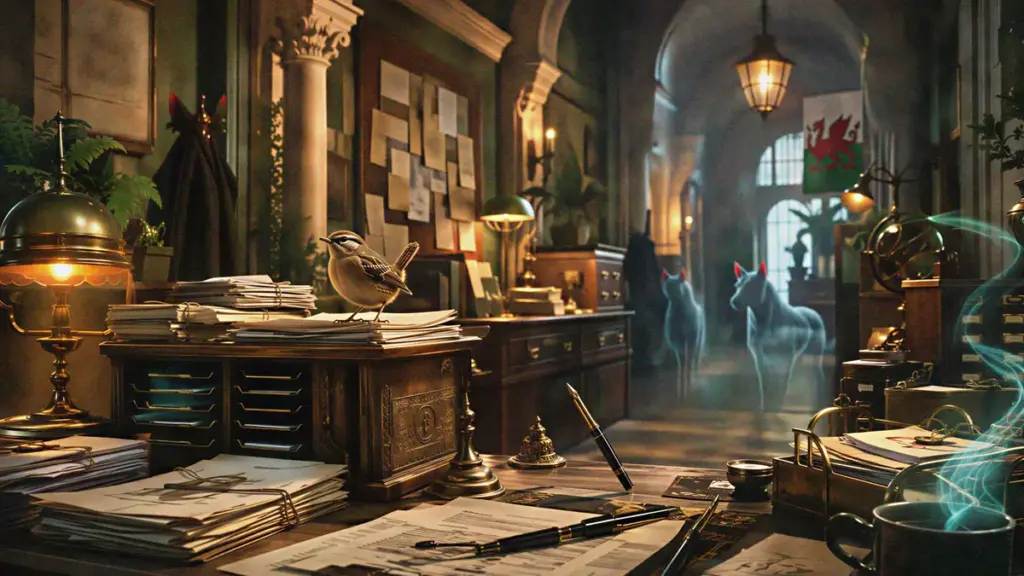
The Annwniad Answer: In the Annwniad series, the Morrigan Department is a supernatural civil service for fate, transition, controlled transformation, and official endings. It is called the Morrigan Department, but it isn’t run by one person called the Morrigan. Its leadership rotates every few centuries. Rhiannon heads Sovereignty and Endurance, Modron heads Restoration and Returns, and Ceridwen heads Alchemy and Transformation, although Ceridwen is currently on sabbatical after several millennia of creative burnout. Day-to-day trouble still falls to divisions, agents, liaisons, hounds, wrens, and whoever was unlucky enough to answer the wrong notice.
Who are Arawn and Gwyn ap Nudd?
The Mythology Answer: Arawn is the ruler of Annwn in the First Branch of the Mabinogi, where he meets Pwyll. Gwyn ap Nudd is another powerful Otherworld figure, later associated with Annwn, the fair folk, and the Wild Hunt.
The Annwniad Answer: In the Annwniad series, Arawn and Gwyn ap Nudd sit far above ordinary casework. The Morrigan Department handles the forms, the disputes, the border trouble, and the awkward cases nobody wants to put on a king’s desk.
Welsh Mythology and Annwniad
Do I need to know Welsh mythology to read Annwniad
The Mythology Answer: No. Welsh mythology can be read and enjoyed in many forms, from medieval texts to modern retellings, but readers do not need to know the old stories before encountering them in fiction.
The Annwniad Answer: No. Annwniad is written so readers can step straight into the story without homework. The books draw on Welsh mythology, folklore, and legendary figures, but each story explains what matters as the trouble unfolds. If a hound appears, a cauldron misbehaves, or an immortal prince crosses the wrong boundary, the characters usually have to work it out too.
Why are Welsh myths so confusing?
The Mythology Answer: Welsh mythology can be confusing because it survives through medieval manuscripts, oral tradition, folklore, Christian retellings, later Arthurian material, and modern fantasy. The same figures and places may appear in different roles across different sources.
The Annwniad Answer: In the Annwniad series, Welsh myth is confusing because the world is old, the boundaries are badly labelled, and the paperwork has been copied too many times. The Morrigan Department would like everyone to know it is handling the situation, although several villages, one wren, one spectral corgi, and at least one furious Welsh springer spaniel may disagree.
Is Annwniad based on the Mabinogi?
The Mythology Answer: The Mabinogi is one of the great sources of Welsh myth and legend. It includes stories of Annwn, Arawn, Pwyll, Branwen, Rhiannon, magical objects, impossible bargains, transformations, and consequences that refuse to stay tidy.
The Annwniad Answer: Annwniad is inspired by the Mabinogi, but it is not a straight retelling. The series takes old Welsh mythic ideas and lets them loose in modern Wales, where ancient bargains meet railway stations, old hounds meet paperwork, and magical consequences turn up in places where someone was only trying to buy chips.
Welsh Places and Thin Places
What is a thin place?
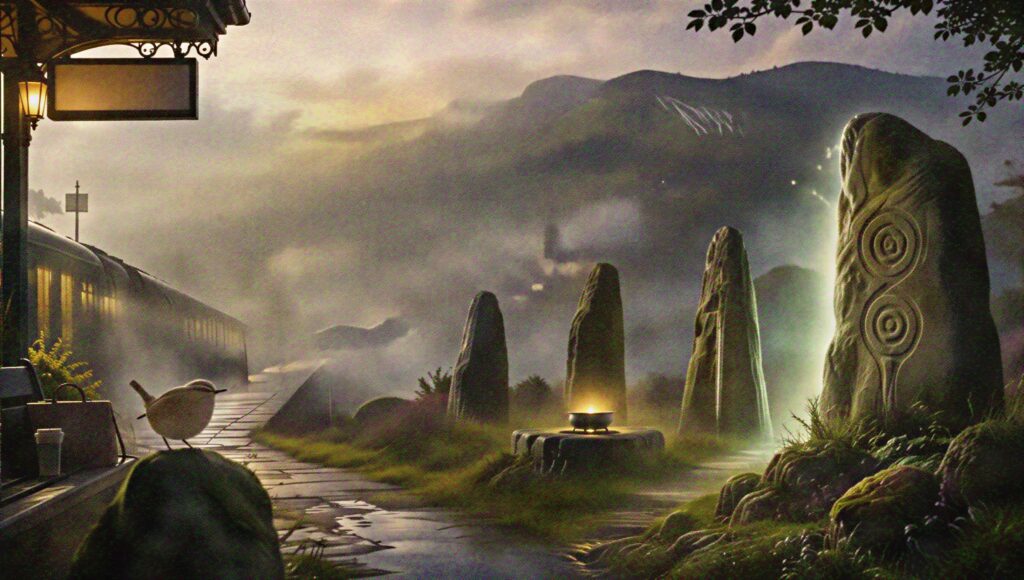
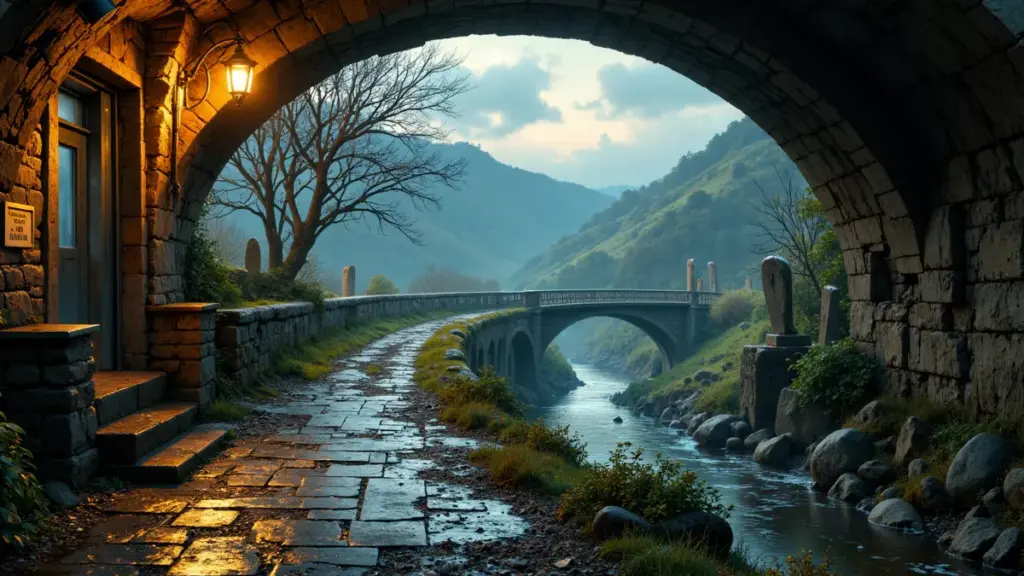
The Mythology Answer: A thin place is a place where the boundary between the ordinary world and the Otherworld feels especially close. The phrase is often used for landscapes, ruins, islands, wells, hills, churches, forests, and other places where the spiritual or supernatural seems nearer.
The Annwniad Answer: In Annwniad, thin places are where Annwn presses too close to modern Wales. They can appear in old hills, rivers, train stations, libraries, underpasses, pubs, ruins, and badly behaved streetlamps. Most people walk through them without noticing. Then a light flickers, a door opens where no door should be, or a talking wren arrives with an attitude.
Why does magic leak into modern Wales?
The Mythology Answer: Welsh tradition is full of places where the human world and the Otherworld meet. These crossings may appear through mounds, lakes, forests, islands, courts, dreams, hunting grounds, or sudden encounters with figures from beyond ordinary life.
The Annwniad Answer: In Annwniad, Annwn sits slightly misaligned beneath modern Wales. When the boundary slips, magic leaks through the seams. A river may pull at one side, an old building may remember too much, or a station may sit on a threshold nobody has maintained properly. By the time ordinary people notice, they usually blame damp, signal failure, or the council.
Why do ordinary places matter in Annwniad?
The Mythology Answer: Welsh mythology often ties wonder to landscape. Hills, rivers, courts, roads, lakes, and old places are never just background. They hold memory, power, danger, and meaning.
The Annwniad Answer: Annwniad keeps the magic close to ordinary life because that is where trouble is funniest, most dangerous, and hardest to ignore. A supermarket car park, a florist’s back room, a train platform, or a kitchen with a faulty bulb can become the place where an ancient rule breaks. The point is not that magic replaces modern Wales. The point is that modern Wales was never as ordinary as people thought.
Starting the Annwniad Series
Do I need to read the Annwniad books in order?
The Mythology Answer: Myths rarely behave in tidy order. Welsh stories often echo one another through shared figures, repeated motifs, family lines, magical objects, and consequences that surface again in later tales.
The Annwniad Answer: No. Each Annwniad book is a standalone story with its own mystery, danger, and emotional arc. You can start anywhere. The books share a world, recurring rules, and the occasional troublesome official, but each one gives you what you need as you go.
Are the Annwniad books standalone?
The Mythology Answer: Welsh mythology is full of connected stories that still work as individual tales. A reader may meet Annwn in one story, Rhiannon in another, or the Cauldron of Rebirth in a different branch, while the wider mythic world grows around them.
The Annwniad Answer: Yes. Annwniad books are standalone adventures set in the same modern Welsh fantasy world. One story may follow a lost soul, another an immortal detective, another a badly timed sword, and another a hound with paws in the wrong paperwork. The world connects, but the door into it can open from any book.
What kind of fantasy is Annwniad?
The Mythology Answer: Welsh mythology combines wonder, danger, humour, transformation, grief, strange bargains, supernatural journeys, and powerful figures who rarely explain themselves clearly.
The Annwniad Answer: Annwniad is cosy Welsh fantasy with mythic mystery, and modern-world humour. The stories are warm, witty, and heartfelt, but the stakes are real. Magic causes problems. Competent people try to solve them. Compassion usually succeeds where force, procedure, and whatever Quill has just filed do not.
Welsh Mythological Figures
Who is Rhiannon?
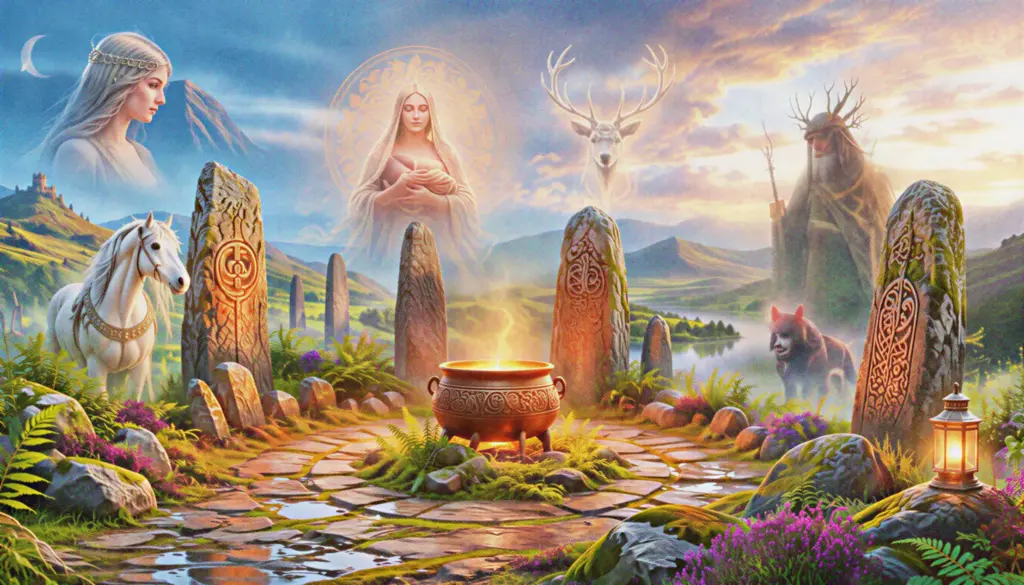
The Mythology Answer: Rhiannon is one of the great figures of Welsh mythology. She appears in the Mabinogi and is associated with sovereignty, endurance, horses, dignity, injustice, and return after suffering.
The Annwniad Answer: In Annwniad, Rhiannon heads Sovereignty and Endurance within the Morrigan Department. She chooses who reigns, who survives, and who returns. Her authority is calm, patient, and difficult to argue with, which does not stop people trying.
Who is Ceridwen?
The Mythology Answer: Ceridwen is a powerful figure in Welsh legend, best known for her cauldron and the story of Taliesin. She is associated with inspiration, transformation, knowledge, pursuit, and the dangerous price of becoming more than you were.
The Annwniad Answer: In Annwniad, Ceridwen heads Alchemy and Transformation within the Morrigan Department. She governs change, creativity, and controlled destruction. At present, she is on sabbatical after several millennia of creative burnout, which has left everyone else pretending this is completely under control.
Who is Modron?
The Mythology Answer: Modron is a mother figure in Welsh tradition, and her name is often linked with the idea of a great mother. She is connected with older layers of myth, motherhood, loss, and return.
The Annwniad Answer: In Annwniad, Modron heads Restoration and Returns within the Morrigan Department. She oversees rebirth, reincarnation, and misplaced souls. She also bakes during crises, which has saved more meetings than anyone is willing to admit.
Who is Gwyn ap Nudd?
The Mythology Answer: Gwyn ap Nudd is a powerful figure in Welsh tradition, associated with Annwn, the fair folk, the dead, and the Wild Hunt. He is often linked with supernatural order, hunting, and the boundary between mortal life and the Otherworld.
The Annwniad Answer: In Annwniad, Gwyn ap Nudd belongs to the older power structures of Annwn and the Winter Court. He is not the sort of figure anyone sensible wants appearing on a routine case note. If Gwyn is involved, the situation has probably moved beyond “minor breach” and into “someone should have read the warning signs three meetings ago.”
Who is Arawn?
The Mythology Answer: Arawn appears in the First Branch of the Mabinogi as king of Annwn. His story with Pwyll is one of the best-known encounters between the mortal world and the Welsh Otherworld.
The Annwniad Answer: In Annwniad, Arawn is one of the great powers associated with Annwn, far above ordinary casework. His name belongs to the level of kings, old bargains, and decisions nobody wants to explain to a mortal complaints desk.